Thursday, April 17, 2014

Blog #12 The End

     Wow, I can't believe this is almost over.I feel like this year has just flown by! (sorry for being so cliché...)  When I first decided on taking this class I was super excited about it, because I had always wanted to learn more about Latin America. This class has met and exceeded my expectations. I feel like I know so much about Latin America now (though I know there's still much more to learn). I'd say that the indigenous cultures, the Conquest and the Mexican Revolution were probably the most interesting things we talked about. And my favorite assignment both semesters was the final project documentary, I just had so much fun making these and thought it was much more enjoyable than writing a paper. I also liked the writing of the blogs, but I think that homework assignments should not be due the same day as a blog because this semester felt like we had a lot more to do.

     A big thing I owe to this class is helping me to figure out what direction I want to go in life. Let me elaborate; upon arriving at college I was dead set on being an orthodontist. That meant 4 years of science classes here, then 4 more years in dental school, and then 3 more years specializing. Now I'm a Spanish major and I feel fifteen billion times better about my life. I realized that I shouldn't base what I'm doing for the rest of my life on my family's expectations and ideas. This class kind of forced me to accept who I was, and that Spanish was my true passion. Whenever Serrata would give us readings in both Spanish and English, I found myself always trying to read them in Spanish first. This class also forced me to realize that the world is such a bigger place than I thought. Now I'm planning on studying abroad in Chile for a whole semester, and I'm looking forward to it immensely. Honestly, at this point I could actually see myself living in a different country and being part of a whole new culture, whereas before I wanted nothing more to get married and settle down in my hometown of Grand Ledge. Now I can really see myself doing anything and everything. Granted this might be in part due to college in general, but I think a lot of it stemmed from this class. This class really opened my eyes and got me to consider the possibilities.

     My final thought is once again super cheesy, but I really loved getting to know all of you guys :) I would not have adjusted to college nearly as well without the friends I have made from this class :) I enjoyed working with all of you and getting to know everyone. I found it really interesting that we are all such different people, with different majors and backgrounds, but we all shared the common interest of Latin America. Thank you all for making this year great, and I hope that when we see each other on campus in the coming years we will do more than just a nod of acknowledgement, but we will actually talk and remain friends. :)

Tuesday, April 1, 2014

Response to Stephanie's Blog

"Oh my gosh he flipped her!" Haha I really enjoyed watching these videos! I totally wish that I could dance like that... Maybe someday (but for reals probably not). I thought it was interesting to learn that salsa originated in New York yet we all still think of it as a Latin American dance. But I think that's pretty cool too, because it shows how things like ideas and dances are not contained by national borders. These people dancing are so good, I am so jealous. When you watched it were you super impressed with all of the dancers too?

Sunday, March 30, 2014

Blog #11 Bill Stewart

     So if you guys remember Professor Stark told us on Friday about how the ABC cameraman Bill Stewart was killed in Nicaragua. He also said he couldn't find the video to show us though he said that he would like to because of the importance of this footage. Stark told us that this video was what created U.S. awareness and interest in Nicaragua. So I went out and found the footage.

 
     I think this video can be seen as a connector of the two parts of our class. It shows how directly primary sources can affect the world. In class we usually read or watch something and then talk about what it is referencing in the world at the time. Well this time I think it's the other way around. This video changed what people thought about Nicaragua. It made people realize how corrupt the government was, and what atrocities were happening there. I believe this is an example of how the media can be used for good. After this video was shown, the U.S. and other countries withdrew their support for the Somoza regime. Jimmy Carter said about the incident "The murder of American newsman Bill Stewart in Nicaragua was an act of barbarism that all civilized people condemn." This helped the Frente Sandinista Liberacion Nacional to take power. In power they instituted many reforms to try to help the Nicaraguan people their biggest being a huge literacy campaign. Later the U.S. would get involved again and ousts the Sandinista government by supporting the Contras because we were too scared of socialism. The corrupt dictatorship of the Somoza family was ended in part by this video and I think that is truly amazing- that a one minute video could have such an impact. 

Monday, March 24, 2014

Response to Gabby's Blog

You bring up a very good point here Gabby. I learned about the Desaparecidos in my Spanish class in high school and I was completely horrified. It's hard for me to believe that the United States just sat by and let this happen- and even worse, that we were involved in installing the government that did this! Like you said, I would hope that if something like this happened today that we would step in and try to stop it, but at the same time we have to be cautious. Maybe when the U.S. supported the government back when, they also thought they were doing the right thing. If we went to try to help again, maybe we would once again end up making the situation even worse for the people that lived there. Foreign involvement is a very tricky situation- is it better to try and help and possibly worsen the situation? Or is it better to stay away and let other countries go their own course

Sunday, March 23, 2014

Blog #10 Who Should Own the Art?

     On Friday I really enjoyed going to the Art Gallery Support Building, partly because it was such a beautiful day, partly because I love walking, partly due to the comfy chairs, and partly to do with Posada's prints that we got to look at :)
     As we sat there discussing Posada and his importance to Mexico my mind couldn't help but wander to one of my favorite Nancy Drew computer games... In Secret of the Scarlet Hand, Nancy Drew is working at a Museum in Washington D.C. when there is an art theft. She then (as the super sleuth that she is) tracks down the thief. Now I realize this seems like quite the stretch to our class on Friday but bear with me. So in this game Nancy talks to a man from the Mexican consulate who believes that the museum should not have had the piece of art to begin with (it was a Mayan artifact). He believed that artwork belonged to the country that it was discovered in, and it should stay there. As he says "If people want to learn about Mexico, why do they not travel to Mexico?" I couldn't help feeling some of the same feelings as Alejandro. Why does Grand Valley State University, in Michigan USA have 10% of Posada's works? I just thought that was ridiculous. What gives us the right to take this history from Mexico? Does it not belong there for the Mexican people to appreciate as it is THEIR history? Why is a class of freshman at Grand Valley able to look at Posada's work and not a Mexican class?
     I'm sorry if I sound unappreciative, I really did enjoy getting to see some of Posada's work- I thought it was very cool! But at the same time, I wondered what gave me the privilege to? Just because a guy with money knew of guy that knew a guy?

 
As a side note, I loved this game so much (and learning about the Maya) that this game is one of the reasons I started taking Spanish classes, which eventually led to me taking this Latin American Civilization class!

Tuesday, March 18, 2014

Response to Jacqueline's Blog

I really like the point you make in this post! I have actually been thinking along the same lines. I learned about Cuba in my A.P. U.S. History class, and I am awestruck at how much was left out. I thought this especially when we were talking about the Cuban Missile Crisis. In that class we were basically taught that Cuba was trying to provoke a war because they hated the U.S. I definitely think that we need to be active citizens and look up additional information and opposing views of event that happen.

Blog #9 What is the point?

     I think we can all agree that our reading lately have been a little more cryptic than usual. Nothing seems to mean what you think it means. As you read you can't just read the surface level of the story, you have to delve into symbolism and juxtaposition of words and directions used and word choice and all sorts of literary tools to get the actual meaning of the story. So after reading, and rereading and doing the questions, and asking Gabby, and looking over it another time, and talking about the story in a class discussion, I am finally able to understand the purpose or the meaning behind the story.
      My thought for this week is what is the point? Why do these authors hide their meaning in-between the lines of their work? Why does it take so much thought just to try to figure out what the author is trying to say? Why doesn't the author just go right out and say it? Wouldn't that be so much easier? Especially with the stuff we've been reading recently. Who is the target audience for this stuff anyways? I dearly hope it is not everyday people of the country. In most the countries we've been studying in Latin America, there is a very low literacy rate, or if the people can read, it is not near the level of these writings. How do the authors expect everyday people to decipher the meanings behind these stories? I wonder if they don't. Maybe these stories instead are targeted toward the wealthy social elite, or even people in the United States. It almost seems like it is leaving out the uneducated of the countries. Who is writing for the everyday man who  works at a farm all day in order to feed his family? It definitely is not the authors that we have been reading.
    

Sunday, March 9, 2014

Response to Grace's Blog

I like how you connected this class with your high school Spanish class! As I was reading your blog I thought that the story was a little bizarre, violent, and depressing as well. This seems to be a bit of a running theme with the pieces that we read in class. I wonder if this shows us something about Latin America though. That their lives were/are full of atrocities like these, and that is why they write about such horrible things. Our lives are so great here in America, I believe we often don't think about the lives of people somewhere else.

Blog #8 Assassination

     So over Spring Break my brother and I got to talking about history (big surprise). We talked about all sorts of random things and then got more specific on assassinations when Caesar and Brutus came up. I told him that if he found assassinations interesting he needed to study Mexican history, because as we all know it is chock full of them! He then surprised me by knowing about Zapata and Villa's assassinations, so I asked him where he learned that. He then giddily ran to his room and brought me one of his history books, Assassination- A History of Political Murder. We started flipping through the pages as if we were kids again- sitting next to one another looking at all the pictures and talking. (I'm a little sentimental, can you tell?) Anyways, he gave me the book to look at, so I of course read the section on Zapata and Villa.
     In class we talked a lot about Zapata's assassination because of course, we watched Viva Zapata. After reading from this book however, I found Pancho Villa's assassination of more interest. So after Obregon became president, Pancho Villa kind of retired to a ranch in the north. You would think he would just be a happy ol' retired man, sittin' on his front porch, but no. At almost all times Villa had 50 armed bodyguards protecting him. He lived in constant fear of being murdered and was said to do weird things like never let anyone walk behind him. But he was a good member of society, he funded a school for children and was a godfather to many children as well. One of his men had a son and asked Villa to be his godfather, so Villa traveled to a nearby town to do such. On the way there he stopped in Parral, probably to spend time with a mistress. As he was driving on the street, men with rifles were waiting on the rooftops to shoot him. This is the part that intrigues me; the assassins did not shoot Villa that day because a crowd of schoolchildren appeared because school was let out. I am just so surprised by the humanity of the assassins. I feel like whenever I picture assassins I always think of men with no feelings, cold blooded killers. But in the end maybe I'm wrong. These men had orders to kill Villa at this intersection in the road, but they hesitated because of the children. I guess we will never know their true motives, maybe they just didn't want bad publicity if they accidently hit a child. But I would like to think that it was out of the goodness of their hearts that they did not shoot Villa when the children were around. What do you think?

Tuesday, February 25, 2014

Response to Alex's Blog

I think it's pretty cool that you looked up additional information about women in the Revolution! I agree that in The Underdogs, the women were portrayed as subservient to men, especially Camilla. But I also wonder if Pintada was more like a Soladadera. We did not specifically read that she fought with the men, but she did everything else with the men and acted like a man so maybe we can infer that she fought as well? Just something to think about :)

Blog #7 La Catrina

     I don't know about the rest of you, but in my Spanish classes in high school we always had a fiesta to celebrate Cinco de Mayo and The Day of the Dead. In reality, I think these were just used as an excuse by my teachers to have a fiesta and let us students have some fun. But still, over the four years I did learn a little. In the mural Sueño de una tarde dominical en la Alameda Central  by Diego Rivera that we have been studying, La Catrina is right in the center so I'm pretty sure she's important.
File:Calavera de la catrina.gif
    La Catrina started out as a political cartoon by Jose Guadalupe Posada in a newspaper around 1910. It is no coincidence that La Catrina appeared just as the Mexican Revolution was starting. Posada helped the illiterate people of Mexico to understand the problems with the Porfilian regime. La Catrina originally represented Mexicans that tried to pass themselves off as Europeans, and abandoned Mexican traditions.
    La Catrina was not an original idea by Posada though, she has deeper roots. She was based upon the Aztec Mictecacihuatl, goddess of death and Lady of Mictlan, the underworld. La Catrina came to represent the Day of the Dead. Other countries do not look as death the way that we do. In Mexico death is a time to celebrate. During the Day of the Dead, people go visit the grave sites of their loved ones that have passed away. Some hold the traditional belief that the dead return to earth this day and give council to the living. People bring candles, flowers, and favorite foods of the deceased and leave them at the grave. Then the family gets together and eats and tells favorite stories about the person who has died. It is a celebration for the family, where they celebrate the life of their loved one. Mexicans keep death close, treating it with familiarity instead of dread. La Catrina embodies this philosophy, that death should be celebrated because it is just another stage of life.

Tuesday, February 18, 2014

Response to Lucas's Blog

I really like that you chose to focus on women for your blog post this week, I found it very interesting! I think it meant a great deal that the rebels included women in their fighting and gathering of supplies. I have to disagree with you though on your point saying feminism in the US was merely non-existent in the early 20th century. Elizabeth Stanton and Susan B. Anthony were women of the late 1800's. They were the founders of the women's suffrage movement here in the United States. And the Seneca Falls Convention which is now viewed as the start of the feminist movement in the U.S, took place in 1848. In 1861 the Civil War erupted, pushing women's rights aside for a time. But once the war was over, women pushed even harder for equal rights. In 1920 women gained the right to vote in all parts the United States. This did not happen in Mexico until 1947, twenty seven years after the United States. So in my opinion, the U.S. was more open to feminism than Latin America in the early 20th century.

Blog #6 Pancho Villa

     About a month ago my older brother (a bit of a historian buff) asked me to tell him about Latin American history since that is one of the areas of the world he does not know much about. I proceeded to tell him the interesting stuff we'd been learning at the time, like the Spanish Conquest, and the Independence movements and such. He then proceeded to ask me about Pancho Villa (which he always mispronounces).
     At that point in time I had no answer for him. I knew less than he did about Pancho Villa, but I told him that we'd have another discussion once I had learned about him. Well we've been talking in class a great detail about the Mexican revolution. I now know the role that Pancho Villa played in the revolution, but I feel like I am still lacking some information. Where did he come from? Why did he get involved in the war? Well I was surprised to find that Pancho Villa had an interesting life before the war.
     His actual name isn't Pancho Villa, he was born Doroteo Arango, and he was the son of a sharecropper in San Juan del Rio. When he was 15 years old his father died, so he had to take on many responsibilities and work as a sharecropper in his father's place. Then one day, a year later, Villa heard that the owner of the hacienda he worked for was planning on raping Villa's sister. He then shot the owner and fled to the mountains. Two years later he was a leader of a group of bandits that he met in the mountains. They would steal from and commit crimes against the rich, and would often help poor members of the community. This is why Pancho Villa is often looked up to, he is a real life Robin-Hood.
     There are multiple theories as to why he changed his name from Doroteo Arango to Pancho Villa, it is hard to say for sure. Some say it was the name of another bandit leader, others say it was his grandfathers name, others speculate that it was to protect his family from trouble. Madero heard about Pancho Villa and his skills and thought he might be a good general in guerilla warfare in the revolution. So Villa was asked to join and, as we know, he did and became one of the greatest generals of the Mexican Revolution.

Thursday, February 13, 2014

Response to Matt's Blog

Hey Matt, I really enjoyed your blog post! Can't say I agree on you with everything, but I enjoyed it :) Your post really helped me to understand the opposite side of the argument about the U.S involvement. And I do agree with you on some of your points. I especially like how you said that it should not be just the U.S. intervening when there is a humanitarian crisis in another country. I totally think that the U.S. should help, but I do agree that other countries need to help to; if we all worked together it would be less of a strain on everyone. However that would make logistics and figuring out who is in charge and how to go about helping, more difficult. But this could be a good exercise for countries- it would force them to work together thus forming bonds and ties to one another, encouraging global unification.

Blog #5 Theodore Roosevelt

     So these past few classes we have been discussing Dario's poem addressed to Theodore Roosevelt. Additionally we have been talking about Roosevelt's imperialistic policies towards Latin America. I agree wholeheartedly that Roosevelt was interfering too much in Latin America. It is one thing to try to help a developing nation, it is a whole other thing to try and take it over.
     But as we have been discussing I have repeatedly thought that our class was kinda bashing on Theodore Roosevelt. I realize why, but it still just didn't sit too well with me. Therefore I decided to dig up some old A.P. U.S. History notes and talk a little bit about the good aspects of Roosevelt. This may help some to understand why he is viewed by some Americans of as one of The United States' most important presidents whereas Latin American countries view him as a villain.
     The main difference I came across is the difference between Domestic and Foreign policy. I think we can all agree that Roosevelt's foreign policy kind of sucked. His main goal was to obtain control over Latin America and also the Philippines. Because of the Monroe Doctrine Roosevelt believed it was The United States' right to intervene in Latin America.
     I believe that the reason that Roosevelt is viewed favorably in the U.S. is because of his domestic policies. To begin with, Roosevelt created what was called The Square Deal. He tried to make things fair in the United States. This began with him coming to the aide of a labor union in the coal mining industry. He threatened the owners of the mills with federal takeover if they did not negotiate with the labor union.
     One of the greatest accomplishments of Theodore Roosevelt was the Sherman Anti-trust Act. After this act was created, Roosevelt attacked monopolies in the American market. He broke them down in order to help consumers in the U.S. First on his list was the monopoly of the railroads by none other than J.P Morgan (that name sound familiar?). He destroyed the monopoly that Morgan had on the railroads which greatly helped consumers. Roosevelt went on to bust many more trusts, making him a sort of a hero to consumers. As I was trying to find how many trust he did bust (sorry, I couldn't find any reliable resources) I came across this disturbing little song that I hope you will enjoy: https://www.youtube.com/watch?v=TvZP93XqyTw
     Furthermore Theodore Roosevelt worked a lot to preserve the nations resources. He worked endlessly to protect the nation's woodlands and mountain ranges. He created many new national forests and protected lands which ended up being around 172 million acres (before his presidency there were only 42 million acres of protected land). Additionally he helped to pass the Meat Inspection Act and The Pure Rood and Drug Act. This made products much safer for consumers.
    So that's what I got for the U.S. perspective on Roosevelt, hopefully that clears up the discrepancy between the United States' and Latin American views.

Monday, February 3, 2014

Response to Leah's Slavery Blog

Wow Leah, great job on your blog! It was a bit of a read but definitely worth it. I really liked all of your comparisons to slavery- especially the modern day ones. It's odd that we don't think of these things as slavery. For instance women in the middle east. I believe that is so very wrong but I would have never linked that to slavery. But in essence it is. It makes me wonder if that is how slave owners felt in Latin America. They knew it was wrong but thought that was just how the world was so they did nothing about it. What a chilling thought.

Sunday, February 2, 2014

Blog #4 No Happy Endings

       I really enjoyed reading Cecilia Valdes for class this week. That and The Slaughterhouse were the most interesting things I have read for this class all year. This of course is due to the fact that these are works of fiction. The last Discussion Question for Cecilia Valdes asked what we thought would happen in the end of the novel. This lit a spark in me, and the ideas started flowing. Creative writing used to be one of my very favorite pastimes, I would write short stories all the time, based on people in my life, far off adventures, or the most randsomest of things. It was my favorite thing to do. But then, my stories started turning out all wrong. Never did I write a happy ending, never were my stories filled with happiness. I stopped writing. I refused to write anything outside of class, even when I had a great idea come to my mind. I did not like my stories. I would write quickly and become filled with the ideas of it all, but upon completion I could not understand how such a nice idea could have turned into such a dark story. It had been years since I had written anything, so I thought hey, why don't I try to finish Cecilia Valdes? Here is what I came up with.


Cecilia ran through the alleyway. “I must escape” she thought. Her beautiful white dress was now torn into shreds and stained with blood. Her usual pretty face was now a haunted view, her eye blackened, her hair tossed and tangled bout. The expression she wore was grotesque, twisted from her fear.
 
            She heard him approach much too late. Cecilia tried to run but was pushed onto the ground like an unwanted doll. Cantalapiedra stood over her, grinning madly.
 
            “Did you really think you could escape me, you filthy mulatta?” He kicked her to the ground as she tried to flee once more.
 
            “Please stop this! I have done nothing to you!”
 
            “Do you think me a fool?” He shouted, “You are the sole cause of this revolution and I will see you pay!”
 
            Cecilia held the hearts of many men- all who saw her were filled with a desirous longing for her. She toyed with them all, using them to advance herself, and when their usefulness wore off, she left their hearts mangled in shreds.
 
            She used black slaves to get her fine things, stolen from their maters’ wives. She used mulattos to get herself invited to finest parties. She used poor Pimienta to make her the belle of the ball. He now played the part of the village fool, playing his broken clarinet on the lowly street corners for spare coins. She used Lorenzo- marriage was not enough for her, she was still seen as a lowly mulatto. What she needed was racial equality, but not for the betterment of her people no, she solely wanted to take what she perceived to be her place at the top of Havanan society. She manipulated Lorenzo into lighting the spark that struck the revolution into a flame.
 
            “Spain will win this war, and it shall start by consuming the viper that started it all.” And with those words he struck his dagger into her heart. “Viva Cuba.” he spat as he turned and faded back into the darkness.
 
            The revolution was soon put down by the Spanish soldiers. The people of Havana had once adored Cecilia, almost worshiped her. But at her funeral only her grandmother, Sena Josepha remained.
 
            “My poor child,” she wailed, “Had you not learned your place, not been so beautiful, blossomed so brightly, then the world might not have plucked you and carried you away."

 
          So yeah, I guess I still cannot write a happy ending. Oh well, maybe I'll try writing again in another few years. Sorry if you hated my ending to the story, I realize it is probably nothing like the original ending so my apologies. This turned into a bit of a personal experiment, sorry if it's super weird.

Sunday, January 26, 2014

My Response to Grace's Sherlock Blog

Grace I love this so much! I too am a BBC Sherlock fan (thank you to Netflix) and I thought this was great! I really agree with all of your points. I think you could take this further though. The next type of gaucho that Sarmiento described was the Bad Gaucho. This could be related to Sherlock when in Season 2 episode 3 he is accused of being an evil mastermind. People in the episode still seem to respect him (it would be an amazing feat in order to make up all of what he was accused of) just as people still had a frightened respect for Bad Gauchos. Furthermore, Sherlock could be compared to The Cantor gaucho. Sherlock is constantly playing the violin- he is a wonderful musician. He integrates his own deeds as the Cantor gaucho does in Season 2 episode 1. He puts his feelings for "The Woman" into his music and it makes it even better. Just some thoughts to add! Love the analogy :)

Blog # 3 Violence

      So I went over to Gabby's dorm room to have a pleasant discussion but then she just HAD to mention that we had to do our blogs this weekend- a fact which I had completely forgotten. So I went back to my room and procrastinated starting it by doing the dishes and listening to music. I was trying to think of something to blog about- maybe something relating to Sarmiento and Echeverria. Then the song "Violence Fetish" by Disturbed came on to my iPod. I started listening and I realized that I might be able to relate it back to the articles. I thought it might be fun to try anyways! So here goes-
    The song starts by saying
"Bring the violence
It's significant
To the life
If you've ever known anyone
Bring the violence
It's significant
To the life"
 
      So that I thought could relate to how Echeverria thought the Federalists and gauchos lived. When he described the scene with the child being grotesquely murdered no one in the town seems to care. Echeverria is trying to imply that these people are so used to blood and violence and that this indicates their barbarism. This goes hand in hand as the song is talking about how violence is significant to life- that it is very important and life cannot be lived without it.
     This next part of the song could be how the Unitarians viewed the Federalists and gauchos of Argentina.
    "How do you sleep
When you live with your lies
Out of your mouth
Up from your mind
That kind of thinking
Starts a chain reaction
You are a timebomb ticking away"
 
       If nothing else, the Unitarians viewed the gauchos and Federalists as an obstacle to progress. The Unitarians believe that they are in the way of making Latin America be like Europe. The Unitarians do not hold he majority in Argentina and they must all have been worried that the caudillos were in power and that the Federalist kind of thinking will destroy the country and any hopes it had for progress (being like Europe.)
       But then the song continues on and it could be viewed as how the Federalists think of the Unitarians. 
"You need to release
What you're feeling inside
Let out the beast
That you're trying to hide
Step right up and be a part of the action
Get your game face on
Because it's time to play
You're pushing and fighting your way
You're ripping it up"
 
      They might believe that the European "proper and civilized" way of life is incorrect- that they should act more as their instincts dictate and not have customs and manners in the way. The second part of the song quote could relate more directly to how Echeverria portrayed the murder of the Unitarian that came to the village. During the attack the Unitarian was "pushing and fighting" his way. He was trying to resist the Federalists at all costs. "You're ripping it up" could refer to the way in which he died- bursting with rage. He was ripping up his insides with rage until he finally died rather than be dishonored. Additionally the song says "Get your game face on because it's time to play" and this could reference how in the end the judge says "Poor devil, we wanted only to amuse ourselves with him, but he took things too seriously." They thought of it all as just a game.
     Then the final part of the song is again from the Federalist/ gaucho perspective.
 
"So tell me what am I supposed to be
Another g***amn drone
Tell me what am I supposed to be
Should I leave it on the inside
Should I get ready to play" 
 
    I think this could explain how the gauchos felt about changing to the European lifestyle. They thought it would turn them into European drones and they would no longer hold onto their native lifestyle and traditions. I believe the last line "Should I get ready to play" could be the Federalists proclaiming that tey were ready for war with the Unitarians if it came down to it.
     Well that's my attempt at relating the song to Echeverria's short story. Sorry if it is a bit of a stretch :).


Tuesday, January 21, 2014

Response to Lucas' Blog

      Lucas this is a very interesting idea! I too had never considered the idea that a nation may not be a good thing. How many wordily conflicts would be avoided if there were not nations? So many conflicts are a result of disputed borders or who is to control certain resources. How many lives would have been saved if we as "civilized" people were not so focused on the nation and the advancement of that nation? In high school we talked a lot about imperialism and the destructive force that it was, how would nations like the Philippines be different if imperialism never occurred? I think that the world would be a much more diverse place. A tad less organized too, but still. Maybe the world would be a happier place if everyone was left alone to do as they pleased in their own societies and were not so focused on becoming a nation.

Blog #2 My Thoughts on the Paper Topics


      I was sitting in the comfort of my living room at home, surrounded by my family. We were discussing ideas for movies to watch and I was lobbying for the Disney movie Aladdin. Disney movies have always been close to my heart. I am the youngest of three children and we used to watch Disney movies all the time. And our parents would watch them with us because, lets face it, Disney is not just for children. That may be the targeted audience, but they are entertaining for all ages because of the hidden jokes or sarcasms that children cannot pick up on.
      Anyways, as we were discussing what movie to watch I saw I had an email that said the paper topics for Latin American Civ were posted. I quick went to check them. I read the first paper topic and was relieved because it seemed simple enough to do- a very straightforward question. I saw the second question was instead, a paragraph and felt terrified instantly. Imagine my surprise when I read that the other option for my essay was to compare ideas in class to Disney songs!
      Then I realized that I had an unimaginable decision in front of me. Should I do the simpler option for the paper that could take less work or thinking, or should I do the paper topic that is based upon a deep love in my life? The internal conflict that this simple decision caused was incredible. When will I ever get another opportunity like this? Should I take the Disney question and hope that my great interest in the subject will get me through the hard work? Or should I just do the simpler question and make my life easier?
       If you cannot tell, I still have not made a decision. I'm planning on making a brief outline for both questions and seeing if that helps me decide. Hopefully it does, because if there was anything I learned from writing the first paper last semester, it was that I am the type of person that needs a lot of time to write my paper and even more time to revise. Just putting it out there that if anyone wants to switch papers and do some peer editing I am totally up for it and would greatly appreciate the help!


Monday, January 13, 2014

Blog #1 Why I chose Latin American Civilization

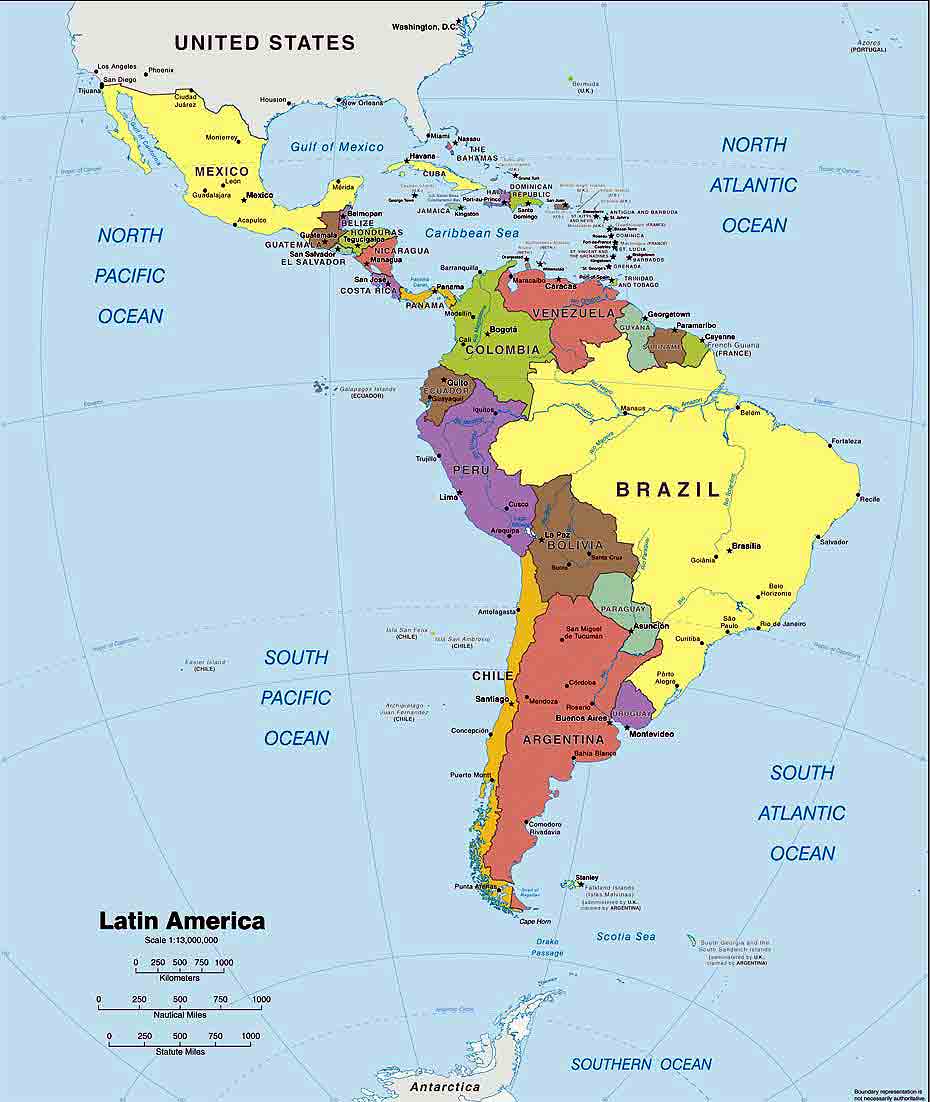
Latin America and Caribbean Region        It is safe to say that Latin American Civilization is by far my favorite class. Despite much opposition, I decided to take it. Everyone in my family told me I should take European Civilization because that part of the world holds more power and influence in our lives here in America. But I wanted to do something different.
        In school I never learned much about Latin America, save for the Spanish Conquest for gold and the United States' imperialist policies towards Latin America. I could not believe that this was all that was important about Latin America. There had to be so much more information that we just weren't being taught in school because they deemed it irrelevant to our culture today.
       Seeing as I am fulheartedly planning on studying abroad somewhere in Latin America, (despite my family's push towards Spain) I think this course will be very helpful to me in this regard. When I go to Chile or someplace in Latin America perhaps I won't be as ignorant as the rest of the world believes us Americans to be.